
Why EV Suspension Wears Differently Than ICE Cars
Jessica Bird | Tuesday 16th June 2026 10:00am
Electric vehicles, in a relatively short space of time, have changed the way a lot of us think about driving. They’re quiet, smooth, quick off the mark, and often feel refined compared to a petrol or diesel car.
They’ve also changed the way we think about maintenance.
Because EVs don’t have a traditional engine, exhaust, clutch, or gearbox in the usual sense, it’s easy to assume there’s less to keep an eye on. And while that’s true in some areas, EVs aren’t maintenance-free. They simply put different demands on different parts of the car.
One area worth paying particular attention to is suspension.
Your car’s suspension does a lot more than just make driving feel comfortable. It helps keep your tyres in contact with the road (over uneven surfaces), supports the weight of the vehicle, manages body movement when you accelerate or brake, and helps the car feel stable through corners. On an electric car, all of those jobs are still happening, but the forces involved can be quite a bit different from those on an internal combustion engine (or ICE) car.
Here’s why EV suspension components can wear differently, and what you can do to look after them.
EVs are usually heavier than petrol or diesel cars
Fundamentally, the biggest difference between EVs and ICE cars is weight.
EVs tend to be heavier than similar petrol or diesel models, mainly because the battery pack weighs so much. Batteries are large, dense, and heavy, and even though they’re usually fitted low in the floor of the car, the suspension still has to support that extra mass every time you drive.
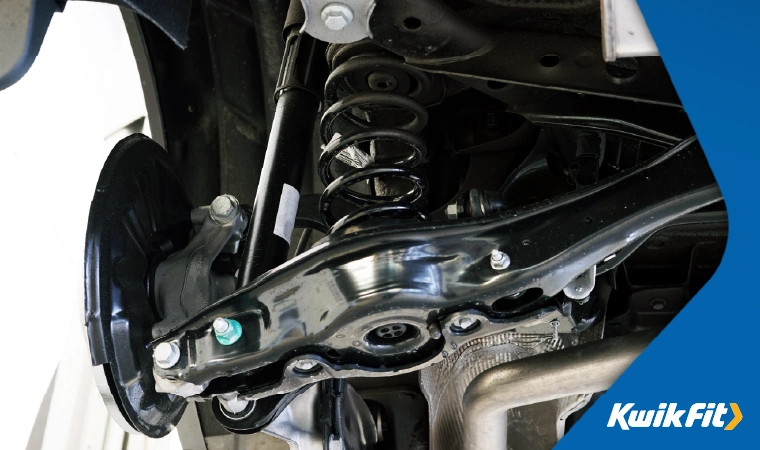
That matters because suspension components are constantly working. Springs, shock absorbers, bushes, ball joints, control arms, and anti-roll bar links are all helping to manage the weight of the car as it moves over the road. It can help here to think of this like carrying a heavy backpack. You can still walk normally and, if the bag is well designed, the weight is spread out properly. But your knees, ankles, and hips are still doing more work than they otherwise would without it.
It’s basically the same with an EV. The car is designed to handle the weight, but the components underneath are still dealing with heavier loads than they might in a comparable ICE vehicle.
The battery changes how the car’s weight behaves
In a petrol or diesel car, a lot of the weight sits around the engine, gearbox, fuel tank, and exhaust system. In an EV, however, the heaviest component (the battery) is positioned low down between the axles. That low battery position does have benefits insofar as it lowers the centre of gravity and can make the car feel planted, stable, and secure on the road – but that can come at the expense of your suspension’s happiness.
A heavier car creates more force when it hits a pothole, goes over a speed bump, corners sharply, or brakes suddenly. Over time, that tends to lead to different wear patterns compared with a lighter petrol or diesel car.
Instant torque is strenuous on components
One of the best things about driving an EV is the instant response. Press the accelerator, and the car just goes. There’s no waiting for revs to build, no gear changes, and no engine noise. It feels smooth and effortless.
But that instant torque also comes with its own set of problems.
In an ICE car, power usually builds more gradually. The engine works through the rev range, and the gearbox helps spread the load. In an EV, on the other hand, the pull can arrive almost immediately – and you end up with a sort of “whiplash” effect on all of the components. Now, you don’t need to drive your EV like it’s delicate, but hard acceleration from junctions, roundabouts, and traffic lights inevitably makes components work harder over time. The suspension has to help control the way the car’s weight shifts as it accelerates, and parts like suspension bushes and mounts have to deal with repeated loading.
This is one reason smooth driving can make a real difference. It’s actually much better for range, too, as well as being kinder to tyres, steering, and suspension parts.
Regenerative braking changes how the car slows down
On the other side of the coin, EVs also slow down differently.
Regenerative braking uses the electric motor to slow the car, while recovering energy and sending it back to the battery. It’s one of the features many EV drivers find odd at first but quickly get used to, and it can help reduce wear on traditional brake pads and discs.
But the suspension is still doing plenty of work.
Every time the car slows, it doesn’t slow down gradually through losing momentum (like an ICE car does), its weight shifts forward. Depending on how strong the regenerative braking setting is, this can happen often during normal driving, even when you’re not pressing the brake pedal.
That repeated forward weight transfer puts load through the front suspension, tyres, and steering components. And these loads can add up at times, like in stop-start traffic, where you’re constantly accelerating and slowing down.
This doesn’t mean regenerative braking is a problem - it’s a useful and efficient system. It just means an EV’s suspension is dealing with a slightly different pattern of movement and force.
Tyres and suspension work together
Tyres and suspension are often talked about separately, but they’re really doing the same job in different ways: that is, they’re helping your car stay stable, comfortable, and in proper contact with the road.
On an EV, this relationship is especially important, because the extra weight of the battery combined with instant torque can put more demand on the tyres. If the suspension or wheel alignment isn’t quite right, the tyres can start to show it quickly.
Uneven tread wear is one of the clearest signs here. You might notice one edge of the tyre wearing faster, or one tyre looking more worn than the others. That can happen when the wheel isn’t sitting at the right angle, which may be down to alignment, worn suspension bushes, or tired shock absorbers.
Keep your EV feeling its best with Kwik Fit
EVs may need less traditional engine maintenance, but tyres, brakes, steering, alignment, and suspension still need regular attention.
At your local Kwik Fit centre, our technicians are always on hand to help you out. Whether your EV feels a little off, your tyres are wearing unevenly, or you’ve recently hit a pothole, we can take a closer look and help keep your car feeling smooth, safe, and comfortable. Book an appointment today.


Any facts, figures and prices shown in our blog articles are correct at time of publication.
Featured Articles
Is it Illegal to Drive With One Headlight?
Saturday 19th July 2025
Wondering if it’s illegal to drive with one headlight? Learn about the safety risks and penalties of illegal blown bulbs and why you should fix them promptly.
Air Con in EVs & Hybrids: Experts Answer Your Questions
Monday 30th June 2025
Does air con drain EV batteries? Can you use the air con while charging an electric car? Find out the answers to these questions & more from Kwik Fit’s experts.
Why Is Your Car Making a Noise? Fixes & Tips
Friday 13th June 2025

When your car starts making unexpected noises, it can certainly be quite disconcerting; it may be nothing to worry about, but here’s what you need to know.